Posts

Dian Fossey's quotation

Image
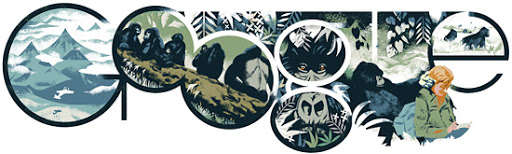
Being inspired by the yesterday's Google doodle dedicated to Dian Fossey (1932 - 1985) I found this very nice quotation from here corresponding to her last entry in her diary: When you realize the value of all life, you dwell less on what is past and concentrate more on the preservation of the future.  http://en.wikipedia.org/wiki/Dian_Fossey

An epic quotation from the Little Prince

Image
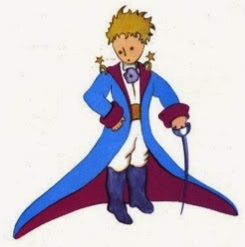
Recently I read a very nice book that I warmly recommend to all of you: The Little Prince by Antoine de Saint-Exupery (1900-1944) . It's a wonderful book for children but - and especially - for adults too. Too many causes for reflection about friendship, dreams, the way we live, the things we think are important (but aren't!) ... everything in a so small book! A must to read! To give you a taste of the book, I report the dedication of the author to his best friend: To Leon Werth I ask the indulgence of the children who may read this book for dedicating it to a grown−up. I have a serious reason: he is the best friend I have in the world. I have another reason: this grown−up understands everything, even books about children. I have a third reason: he lives in France where he is hungry and cold. He needs cheering up. If all these reasons are not enough, I will dedicate the book to the child from whom this grown−up grew. All grown−ups were once children−− although fe...

Tomato Tomato saying

Image
In the last week from a colleague and in the The Big Bang Theory (Season 7 episode 11) I heard a nice and simple English expression that uses the American and British pronunciations of the word tomato. The expression by itself is very simple: " Tomato tomato " but what matters is the prounciation: " toe-MAY-toe , toe-MAH-toe " The meaning of the "tomato, tomato" is to express more clearly that two things supposed to be different, aren't or just have minor differences. It originates from the 1937 song "Let's call the whole thing off" by George Gershwin: " ... you like tomatoes [toe-may-toes] and I like tomatoes [toe-mah-toes]... " (from http://www.ishs.org/ ) Reference: http://en.wiktionary.org/wiki/tomato_tomato

Why do earthworms go on the sidewalks when it rains?

Image
Why do earthworms appear on the soil surface when it rains? Even if this is still matter of study and so there is no ultimate answer, experts agree on what is not the explanation: drowing ! Indeed earthworms do not come to the surface to escape drowning since they are perfectly able to survive several days submerged completely in water (provided there is enough oxygen in it)! As disappointed you might be, you have to know that probably earthworms come to the surface in rainy days just to walk much bigger distances than they can do underground. They breath through their skin that must be wet in order to properly work, because of that, rainy days represent a good opportunity to move safely on the soil surface whereas in dry conditions they would dehydrate and die. In a few words, earthworms like to be faster and they can only when it rains!  :) (from http://www.supercoloring.com/color-online/pages/earthworm/ )

Safari, the long journey

Image
Today I learnt that the word Safari means long journey in swahili , the language of the African Great Lakes region (Kenya, Tanzania, Uganda, Rwanda, Burundi, Mozambique and Congo). More interestingly, the word is used for any kind of journey. In this sense, it is much more general compared to the general idea that we have of a safari like a big game hunt or a trip to observe and photograph wild animals. (from http://www.safari.com/ )

Richard Feynman's epic quote #2

Image
   (image from http://uweanimation.blogspot.com ) "If, in some cataclysm, all scientific knowledge were to be destroyed, and only one sentence passed on to the next generation of creatures, what statement would contain the most information in the fewest words? I believe it is the atomic hypothesis (or atomic fact , or whatever you wish to call it) that all things are made of atoms — little particles that move around in perpetual motion, attracting each other when they are a little distance apart, but repelling upon being squeezed into one another. In that one sentence you will see an enormous amount of information about the world, if just a little imagination and thinking are applied."     Richard Feynman (1918-1988), Lectures on Physics (vol. 1) ---> For other posts on this blog about Richard Feynman click here
Pineapples grow quite close to the ground

Image
Did you know that you don't need a ladder to harvest pineapples? Why? They grow pretty much on the ground! That's why!   (image from wikipedia )